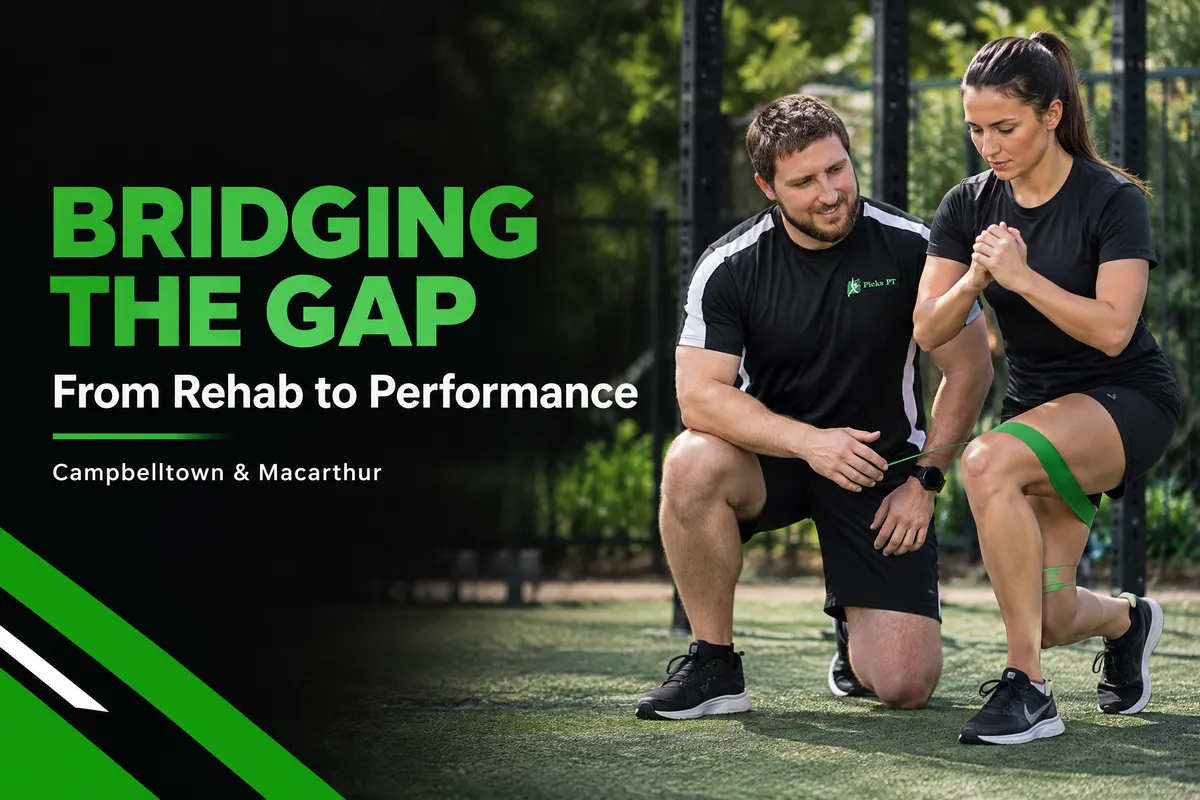
Injury Rehabilitation Campbelltown | Picks PT
From Injury Rehabilitation to Confident Performance
Completing physiotherapy or receiving medical clearance can be an important milestone, but it does not always mean a person feels ready for unrestricted work, training or sport. The difference between basic function and confident performance may involve rebuilding strength, work capacity, movement control and trust in the injured area.
This is where carefully planned return-to-performance coaching can be useful. At Picks PT, Nathan Pickering works with people in Campbelltown and Macarthur who want to rebuild physical capacity after the acute stage of an injury—where appropriate and in line with guidance from their treating professional.
Rehabilitation and coaching have different roles
Doctors, physiotherapists and accredited exercise physiologists diagnose, treat and manage clinical conditions within their professional scopes. A strength and conditioning coach does not replace those services.
Instead, coaching may support the later transition back to higher physical demands once the person has suitable clearance. Communication with the treating practitioner can help ensure that exercise selection and progression are consistent with the rehabilitation plan.
Healthdirect advises people with injuries or physical limitations that a physiotherapist or exercise physiologist may help identify suitable exercise options.2 If pain is worsening, symptoms are unexplained or function is declining, clinical review should come before harder training.
Four priorities in return-to-performance training
1. Gradual exposure to load
The body needs time to tolerate more force, volume, speed and complexity. Progress may begin with controlled movements and moderate loads before advancing to heavier strength work, running, jumping or change-of-direction tasks.
Progression should respond to symptoms, movement quality and the person’s overall recovery—not an arbitrary deadline.
2. Restoring movement confidence
After an injury, people commonly hesitate during movements associated with the original incident. A planned progression can rebuild confidence by starting with manageable tasks and gradually increasing challenge in a controlled setting.
3. Rebuilding the qualities the activity demands
Returning to everyday life may require lifting, carrying, climbing stairs or tolerating a full workday. Returning to sport may require sprinting, decelerating, jumping, changing direction and repeating efforts under fatigue.
The program should prepare the person for those specific demands rather than stopping at general exercise.
4. Managing the whole training load
A returning athlete may also be completing team practice, skills work and conditioning. A busy adult may be balancing training with physical work, poor sleep or family demands. Load from every source matters.
The aim is to create enough stimulus for progress without increasing demands too quickly.
Technique remains the priority
The Picks PT approach places technique before loading. This is particularly important during a return from injury, when compensatory movement patterns may have developed. Exercises should be coached carefully, with loads adjusted when control deteriorates.
Progress is not always linear. Some weeks will move forward quickly; others may require a smaller step. A flexible, evidence-informed approach is more useful than forcing a preset timeline.
Questions to ask before returning fully
Before resuming unrestricted training or sport, consider the following questions with your treating team and coach:
Question | Why it matters |
Have I received appropriate clearance? | Clinical concerns must be addressed first. |
Can I tolerate the basic movement without worsening symptoms? | Basic control precedes higher intensity. |
Have I rebuilt relevant strength and work capacity? | Daily life and sport may exceed clinic-level demands. |
Have I practised the speed and direction changes my sport requires? | Sport is less predictable than controlled rehabilitation. |
Is my weekly load increasing gradually? | Sudden spikes can create avoidable setbacks. |
Take the next step carefully
If you have completed the clinical stage of rehabilitation and want to rebuild strength, capacity and confidence, Picks PT can help you plan the next phase. Medical clearance may be required, and coaching can be coordinated with your health professional where appropriate.
Call to action: Book an assessment with Picks PT to discuss return-to-performance training in Campbelltown and Macarthur.
