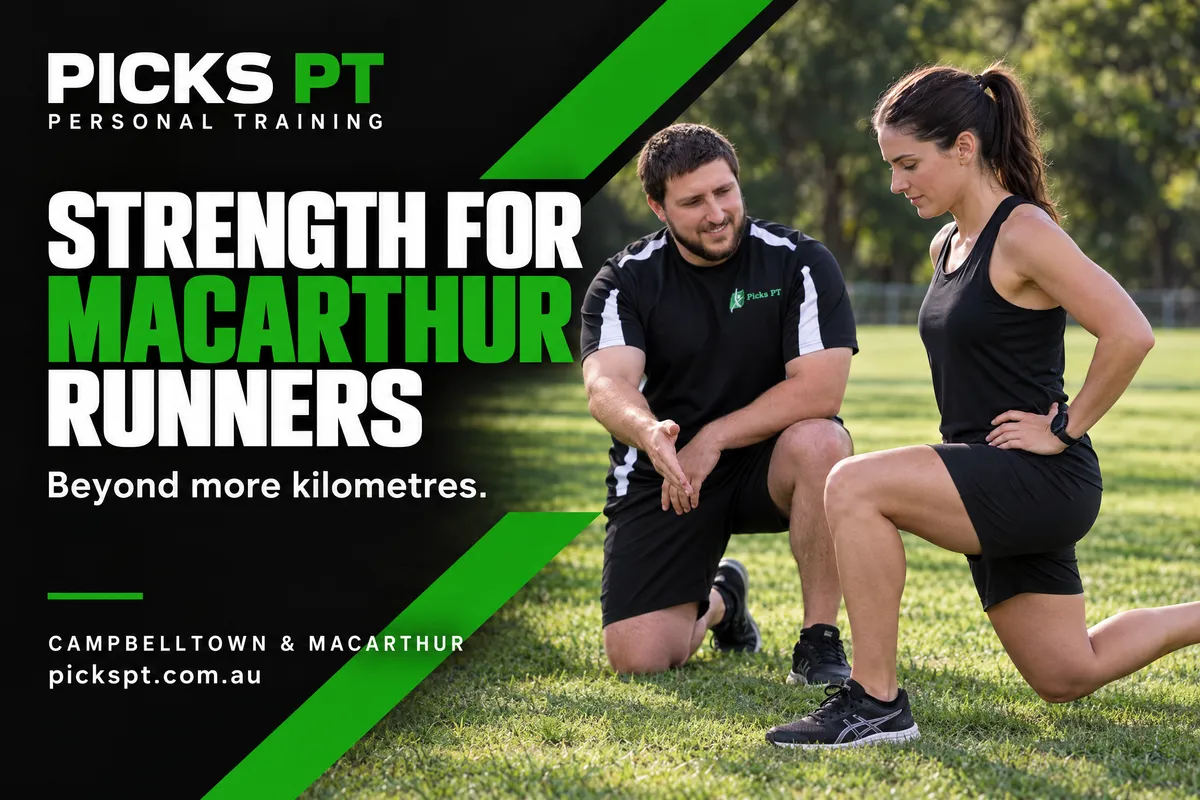
Strength Training for Runners Macarthur | Picks PT
Runners Need More Than Miles
How to think about strength, recovery and scheduling without turning every session into another hard run.
Strength Training for Macarthur Runners: Beyond More Kilometres
More running is not the only training question
For runners across Campbelltown, Camden, Mount Annan and the wider Macarthur region, November can be a useful time to review the routine before summer. Perhaps you are working towards a longer distance, trying to maintain consistency or simply enjoying regular runs. Whatever the goal, adding more kilometres is not the only possible next step.
Strength and conditioning can complement running, but it needs a purpose. A session that leaves your legs exhausted before every key run is not automatically helping. The useful question is how strength work fits the runner, the existing schedule and the training goal.
Picks PT's endurance program focuses on individualised strength and conditioning for runners, cyclists and triathletes in Macarthur, including coordination with existing endurance coaching where relevant.1
What does the evidence say?
Running economy describes the energy demand of running at a given submaximal speed. A 2024 systematic review found that some strength-training approaches—including high-load training and some combinations of methods—may improve running economy. Findings varied with the method, running speed and athlete characteristics.2
That is not the same as promising a particular race time, an injury-free season or immediate benefits from any weight session. It also does not mean a beginner should copy a research protocol involving heavy loads or jumping. Technique, experience and appropriate progression remain essential.
Strength should support the running plan, not become a separate competition for fatigue.
Begin with useful movement foundations
A coach may assess how you squat, hinge, control a step, brace the trunk or work through an appropriate calf movement. These patterns can provide a starting point for strength training, but the exercise and loading should reflect the individual.
For someone new to resistance training, learning the movement is already worthwhile work. For an experienced runner, the discussion may involve gradually developing greater strength or adding more advanced elements when appropriate. Progression is earned; it is not an invitation to rush into the heaviest option.
Program consideration | Why it matters |
Running history | A new runner and a long-term competitor have different needs. |
Strength experience | Technical confidence should guide loading and complexity. |
Key running sessions | Strength work should be planned around the wider week. |
Recovery and work demands | Training load does not exist in isolation from daily life. |
Existing injury concerns | Clinical guidance may influence the starting point. |
Schedule the week, not just the workout
Bring your running schedule to the assessment. Nathan needs to understand the long run, faster sessions, easier days and any other sport or physical work. If you have a running coach, coordinated planning can reduce unnecessary overlap.1
There is no universal placement for every strength session. The right timing depends on the current training block, tolerance and priorities. What matters is reviewing how the work affects your running rather than repeatedly adding sessions without feedback.
Also consider the effect of unfamiliar training. A new movement or workload may need a gradual introduction. A session should not be judged only by how much soreness follows it.
Distinguish general strength from running-specific planning
General strength provides a useful foundation, while a runner's program may later include different loads, tempos or explosive elements. The evidence does not support treating every method as interchangeable.2
For practical coaching, this means explaining why an exercise is included and when it should progress. A few well-coached movements can be more purposeful than a large circuit chosen mainly to elevate heart rate. Your runs already provide substantial endurance work; the strength session should contribute something considered.
Do not turn discomfort into a challenge
Persistent pain, worsening symptoms or a concern about a previous injury needs appropriate assessment. Strength coaching does not diagnose the cause of an injury, and no single exercise guarantees prevention.
Discuss relevant medical advice or physiotherapy guidance before progressing. If you are returning after an injury, Picks PT's return-to-performance support can be considered alongside—not instead of—your treating professional's care.
Frequently asked questions
Will strength training make me a faster runner?
Some approaches may improve running economy, but individual results vary.2A useful program should have realistic goals and be reviewed within the wider running plan.
Should every strength session be intense?
Intensity is only one planning variable. Technique, volume, experience, recovery and the next running session all matter. The goal is appropriate work, not exhaustion for its own sake.
Is endurance S&C only for race competitors?
Picks PT describes support for runners ranging from 5 km enthusiasts to marathoners.1Recreational runners can enquire about an appropriate starting point too.
Make the next training block purposeful
Book a free assessment with Nathan Pickering to discuss in-person strength and conditioning that complements your running in Campbelltown and Macarthur. Bring the schedule, explain the goal and build from there.
